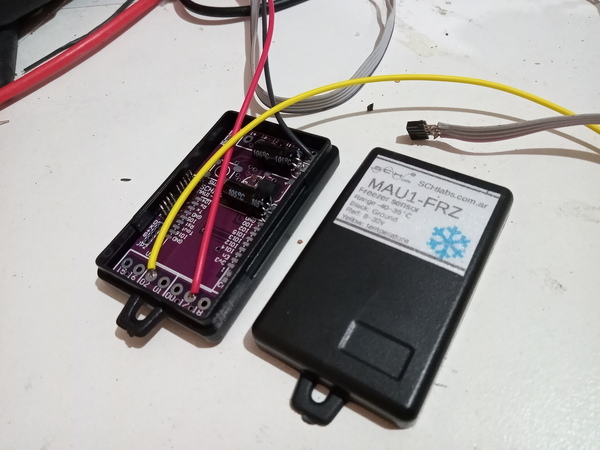
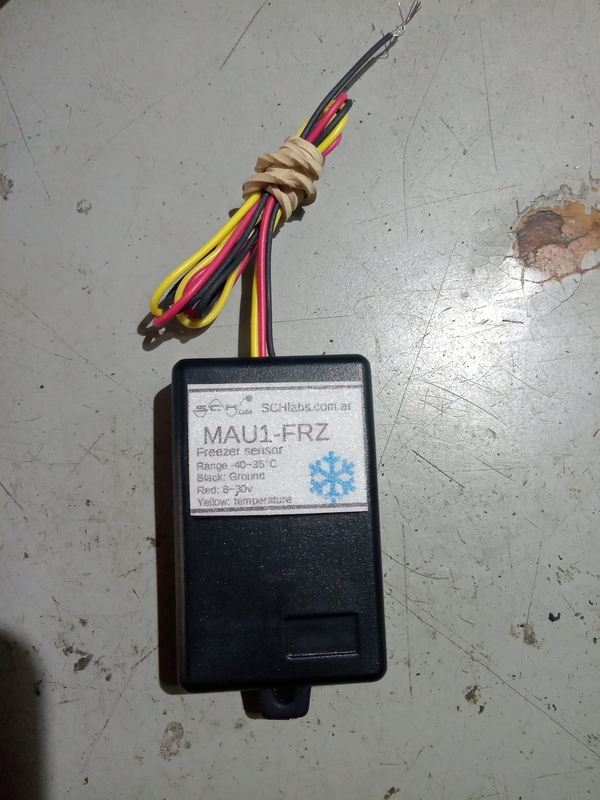
To allow administration, configuration, and compatibility with all GPS tracker providers, this sensor has communication capability.
The connection is made between a USB-serial-TTL adapter and the M2 connector.
Using a terminal program such as HyperTerminal, TeraTerm, screen, etc., open the serial port at 56200,n,8,1, with echo enabled and automatic CR+LF.
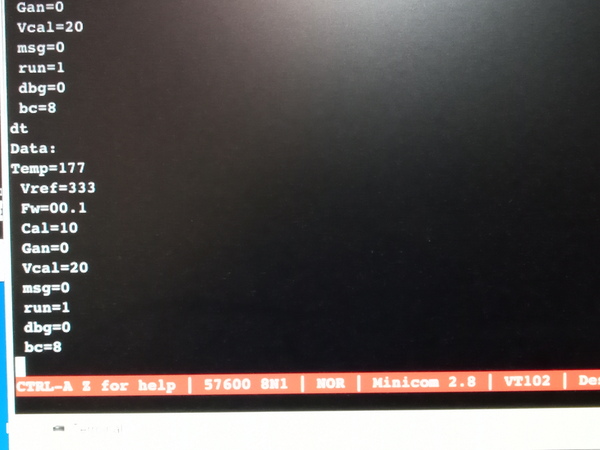
dt
Requests the sensor's internal information.
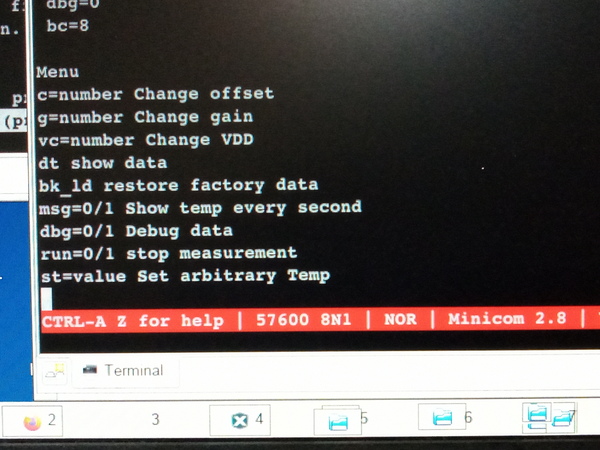
c=[value]
Moves the calibration offset. You'll normally change this value when, at ambient temperature, there's a difference between what the sensor reads and what a reference thermometer reads.
g=[value]
Moves the calibration gain. You'll normally change this value when, at freezer temperature, there's a difference between what the sensor reads and what a reference thermometer reads.
vc=[value]
Adjusts the internal reference voltage; it must be set so the displayed internal voltage matches the value measured with a multimeter.
Temp=[value]
Tells the sensor the current temperature, with one decimal but without the decimal point, so the system can self-calibrate. Note
only works at temperatures above 15 degrees or below -10 degrees, and if the difference from the internal sensor is less than 5 degrees.
msg=[0/1]
1=Enable/0=Disable sending a temperature message once per second.
dbg=[0/1]
1=Enable/0=Disable internal debug messages once per second.
run=[0/1]
1=Enable/0=Disable continuous temperature measurement. This function is only useful at the factory during functional testing. It is not saved in memory, and measurement is always active on power-up.
st=[value]
Forces an arbitrary temperature; the sensor will transmit the value you enter instead of the value it reads.
bk_ld
Loads the factory calibration — ideal if you make a mistake while calibrating.
?
Shows a help menu and the internal data
After each successful change, a summary of all the device's internal data will be shown: